Übergordnete Werke und Veranstaltungen

Installation im Studio
Blumengießer
Personen
Media

Foto: Yvonne Most

Foto: Yvonne Most

Foto: Yvonne Most

Foto: Yvonne Most
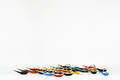
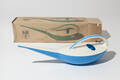
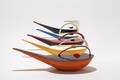

We see a group of 28 watering cans, all with their spouts pointing to the left, giving the impression that the cans are moving together in one direction. In fact, they are arranged chronologically according to their year of manufacture. On the right are the oldest models from the 1960s, and on the far left is the most recent model from the 1970s. With this arrangement, designer Stephan Schulz examines how the appearance of an industrially manufactured object changes when its production and processing methods change, for example when there is a shortage of materials or increased demand. Every detail is an expression of an industrial and product culture, the development of which Schulz recounts using a watering can. Schulz found a watering can from the 1960s in the Nachweis für Besiedlung collection and combined it with his own collection of the same watering can model. The individual models differ minimally, but significantly, in terms of handle shape and spout opening, base area and hollow body size, spout length, and cover plate curvature. The plastic watering can designed in the 1960s by designer Klaus Kunis for VEB Glasbijouterie Zittau (GBZ) evolved over time from a three-part, multicolored model to a two-part or single-color model in which the transition from the handle to the hollow body was no longer elegantly joined but rather carelessly assembled. While initially a relatively high level of detail and variety in color and form were possible, individual assembly steps were later combined, the care taken in workmanship declined, and the entire injection molding process was geared toward centrally controlled, standardized mass production. However, instead of reading this watering can solely as a testimony to the decline of the plastics and elastics processing industry and industrial design in the GDR, Schulze's arrangement allows for another interpretation. If one follows the colorful swarm of watering cans and reads the stream of boat-shaped containers from right to left, then suddenly the seemingly inferior mass-produced product, the orange can at the end of the row, moves closer to a dummy or prototype. As if the design process could start anew from here.