Übergordnete Werke und Veranstaltungen

Installation zum Filmprogramm
Encyclopaedia Cinematographica
Personen
Media

Encyclopaedia Cinematographica, Christoph Keller, DE 2001
© Christoph Keller

Encyclopaedia Cinematographica, Christoph Keller, DE 2001
© Christoph Keller

Encyclopaedia Cinematographica, Christoph Keller, DE 2001
© Christoph Keller
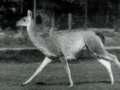
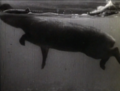
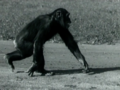
Modern science differs from its predecessors in that it no longer regarded motion in terms of isolated moments, but in terms of any given moment. The analysis of motion was carried out in a visually concrete manner; for example, Galileo related the distance travelled by a falling body to the time taken for it to fall. The analysis of general forms of movement in the living world is one of the key tasks of comparative behavioural research. A science that is very young in comparison to physics. Yet a seamless description of a duck’s swimming movements, capturing every single detail, is practically impossible for a human observer. They will always omit something. It is therefore no coincidence that the emergence of behavioural research coincides with the development of film. With moving images, a system had been found that reproduces movement as a function of any given moment, as Gilles Deleuze writes. Film became the most important documentary material for behavioural research. The films, the majority of which were produced at the Max Planck Institute for Behavioural Physiology in Seewiesen – whose directors included Konrad Lorenz and Irenäus Eibl-Eibesfeldt – were archived at the Institute for Scientific Film (IfW) in Göttingen. In 2001, at the Kunstwerke in Berlin, the artist Christoph Keller curated an installation drawn from the collection of the Encyclopaedia Cinematographica—a film project co-founded by Konrad Lorenz—which made a selection of the archive accessible to the public. The encyclopaedia was originally intended to capture, in brief film clips, the movements of all living animal species. Keller selected forty films from the collection of over a thousand, most of which are two minutes long. He presented them on forty monitors as a parallel universe of rhythmic movements that seem endless as long as the televisions do not fail. Thus, an elephant places both legs on one side of its body simultaneously and sways across the screen in a amble. Giraffes, too, place their legs on the ground in this manner. The studies make it clear that gait, in its manifold variations, not only characterises the species but also ‘has an effect’ beyond that. Sole-walkers such as polar bears stride with a similar purposefulness to chimpanzees and gorillas moving in an ankle-walk. And the flight studies of hummingbirds and insects have more in common with one another than the swimming and diving movements of other birds. The gallop of a boxer and a German shepherd could not be more different, whilst the swimming strokes of the arrowtail crab, which fold backwards and forwards, are organised like the arched spine of the cheetah. Systematic categorisations are thus systematically undermined. Despite the endless loops of the animals’ movements, the arrangement does not conceal the finite, historical nature of nature and science. This is further underscored by the fact that the Institute for Scientific Film in Göttingen has since filed for bankruptcy and is currently up for sale.