Der Tag des Spatzen
Personen

Media


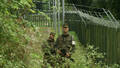
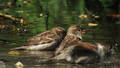
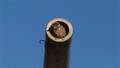
The Day of the Sparrow is a political nature film. It is about a country where the line between war and peace is blurring. On 14 November 2005, a sparrow is shot dead in Leeuwarden, the Netherlands, after knocking over 23,000 dominoes. In Kabul, a German soldier dies as a result of a suicide bombing. The juxtaposition of these headlines prompts director Philip Scheffner to set out in search of war, using the methods of ornithology. In Germany, not in Afghanistan. For here the question arises: are we living in peace or at war?
His journey begins on the Baltic Sea, in 1974 on Super 8, childhood memories of a bird sanctuary between a military training area and a sailing harbour. He meticulously notes down the daily bird sightings, regardless of the roar of anti-aircraft missiles over the bay. Leaving the safe hide behind the dyke, the camera circles, place by place, the reality of war, in images of apparent peace. Dialogues from chance encounters drift as fragments of sound through the deserted landscapes of the Eifel, Moselle and Uckermark, from Bonn to Berlin. Throughout, the birds remain the protagonists, always in the lens’s focus. They perch in gun barrels, on fences, flutter across meadows and fields where war has long left its mark. This is where the war is waged: words and images are used to target the minds and hearts of people in the conflict zones; scientific data is collected and analysed; kites are flown bearing the inscription: Life can be adorned with freedom.
This is not a militarisation that happened overnight. It took place slowly, in the shadow of the Cold War, with the promise of secure jobs. What we must come to terms with is that the emergency has arrived. This war is no longer a theory.
Five cranes circle in the sky, and the soldier takes stock of his deployment in Kabul: a second Vietnam. I wanted to find my peace of mind again. And I like the landscape here, the surroundings. To me, it’s like a fortress. So, looking at it from a psychological perspective. You could call it a ‘golden cage’, but I think ‘fortress’ is better.
In between, in the form of emails, memos and phone calls, the communication between the director and the Bundeswehr. Hidden behind bureaucratic language lurks the fear of the public eye. A political apparatus exposes itself: there’s absolutely no reward for asking questions. And I’d expect that if we show we’re having these discussions and asking questions, it won’t reflect well on our image.
And suddenly the perspective shifts. A friend of the filmmaker is arrested on a country road in Brandenburg. The birdwatchers themselves become the objects of observation. There is no mass movement against this war, making the stance of the individual all the more important: So the point is actually there every day; there is no specific historical phase where it would be worth resisting – there isn’t one. You have to create it yourself.
The film concludes with a shifted perspective on the familiar: a military training area on the Baltic Sea, situated between a bird sanctuary and a sailing harbour. Rocket impacts churn up the turquoise-blue water, over which the birds continue their migration undeterred.